
An Enduring Commitment
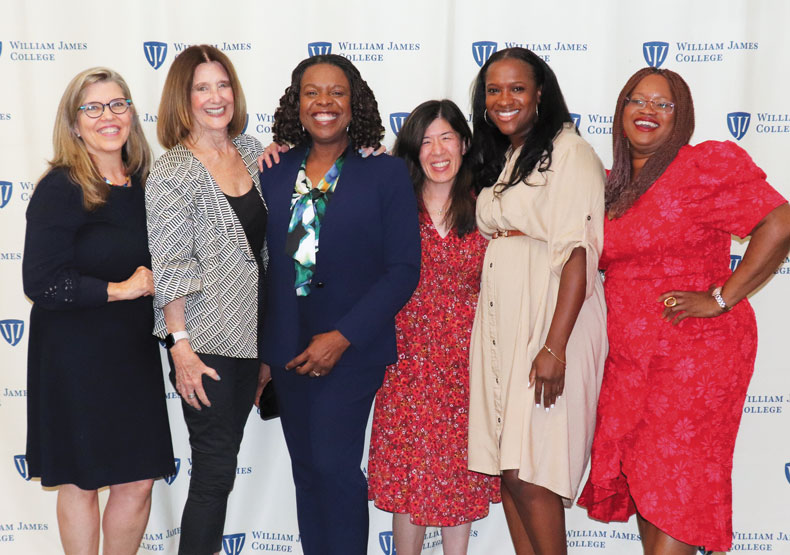
(L to R) Mari Carmen Bennasar, PsyD, Director, Latino Mental Health Program; Jill Betz Bloom, PhD, Director, Global Mental Health Concentration; Gemima St. Louis, PhD, Vice President for Workforce Initiatives and Specialty Training; Catherine Vuky, PhD, Director, Asian Mental Health Concentration; Shani Turner, PhD, Director, African and Caribbean Mental Health Concentration; and Natalie A. Cort, PhD, Director, Center for Multicultural and Global Mental Health
The Center for Multicultural and Global Mental Health Marks Two Major Milestones
 As the cultural landscape grows increasingly diverse and interconnected, the need
for mental health providers who understand the communities they serve has never been
greater. At William James College, preparing the next generation of providers to deliver
culturally responsive care remains a priority—one evidenced by a pair of major milestones:
the 10th anniversary of the Center for Multicultural and Global Mental Health (CMGMH) and the 20th anniversary of the Lucero Latino Mental Health Program (LMHP).
 “Together, we have built programs that clearly communicate to individuals from historically
marginalized and underserved communities that we care about their unique lived experience,”
says Natalie A. Cort, PhD, director, Center for Multicultural and Global Mental Health. Since its founding,
the College’s flagship multicultural pedagogical initiative has helped drive a transformation
in the student body, effectively tripling the presence of underrepresented voices
in graduate programs campus wide. In 2024, the total enrollment of BIPOC and self-identified
minoritized students reached a historic high of 42%.
“This evolution reflects our unwavering commitment to cultivating a diverse behavioral health workforce that truly mirrors the communities we serve,” says Cort, pointing to the Center’s portfolio of offerings. Four culturally-focused academic concentrations in African and Caribbean, Asian, Global, and Latino Mental Health; a pair of leadership pipeline programs; and one applied learning initiative invite folks from diverse cultural backgrounds to better understand the needs of historically marginalized and underserved communities with the goal of reducing mental health disparities within these populations and diversifying the mental health workforce overall.
For Cort, who hails from Guyana, South America, gratitude for those who paved the way is central to culture and community.
“We must acknowledge the shoulders we stand upon and the history we have benefited from,” she says, nodding to the Lucero Latino Mental Health Program and its profound impact on William James College and the field. Over two decades, LMHP has built a high-volume pipeline of 158 bilingual experts—a figure exceeding the total Spanish-speaking provider capacity of many American states. Furthermore, LMHP has single-handedly addressed a critical health disparity that larger, traditional universities, which produce fewer than three Spanish-speaking or Latino-specialized graduates per year, have yet to solve at scale.
“None of the other CMGMH concentrations would exist without the LMHP,” says Cort, a former researcher drawn to the College because she saw its commitment to the mental health of Latinos as a reflection of a broader commitment to underserved communities.
Representation to Impact
What Cort recognized in William James College more than a decade ago has since become a defining part of its community. Today’s CMGMH students are not only studying multiculturalism, they are living it. By the numbers, 77% come from racially minoritized backgrounds and nearly 80% carry the unique insights of the 1st- or 2nd-generation immigrant experience; 40% identify as 1st-generation college students and 40% are multilingual, providing care in languages spanning Arabic to Yoruba and dozens of others in between; and 70% are supported by mission-aligned scholarships ensuring that economic barriers do not stand in the way of social justice. In total, the approximately 500 individuals who have enrolled in CMGMH programs have expanded access to evidence-based mental health trainings and services for more than 2,000 underserved individuals in the United States and internationally.
These numbers tell only part of the story. For Cort, diversity is both something to celebrate and essential to better understanding and serving the communities mental health professionals are called to support.
“We all win when the health experiences of individual groups are considered,” she says, underscoring what gives her hope: “Even when it would be easy to fall back into invisibility, students with complex, intersecting identities are still showing up to a place where they can be seen, celebrated, and understood.”
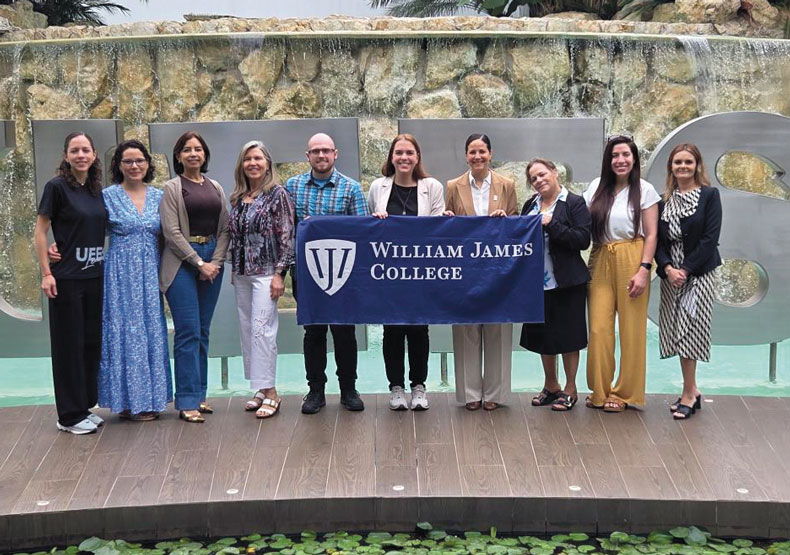
Latino Mental Health Program students and staff at Universidad de Especialidades Espíritu Santo (UEES) in Guayaquil, Ecuador.
- Tags:
- Around Campus