Shira Fishman, PhD
View Profile

Jewish Mental Health
As society becomes increasingly diverse, there is a growing need for mental health providers who possess the knowledge and skills to deliver culturally attuned and evidence-based services to Jewish clients. Jewish individuals represent a diverse and multifaceted cultural, ethnic, and religious community with rich traditions, values, and histories that shape identity and well-being. Simultaneously, Jewish individuals and communities face unique stressors, including but not limited to antisemitism, systemic bias, and trauma, which can adversely impact mental health and access to care.
This concentration is designed to promote students’ awareness and understanding of the diversity within Jewish identities and practices, the role of cultural and communal strengths in fostering resilience, and the impact of antisemitism and related stressors on psychosocial well-being. Cultural competence, responsiveness, and humility are essential in effectively working with Jewish individuals, families, and groups.
For more information on our Jewish Mental Health concentration, please contact our Admissions Office
info@williamjames.eduThis concentration is for students who are interested in learning about and understanding the cultural, historical, and social contexts that shape Jewish identities and experiences. It is designed for students who seek to develop cultural competence, humility, and responsiveness in working with Jewish individuals, families, and communities in diverse settings. Central to this concentration is students’ exploration of their own perspectives, assumptions, and experiences related to Jewish identity, culture, and antisemitism. These perspectives will be examined and challenged as they relate to facilitating or impeding effective clinical, school-based, workplace, and research work.
The Jewish Mental Health concentration combines specialized coursework on Jewish identity, antisemitism, and mental health with trauma-informed and culturally responsive clinical training. Through coursework and experiential opportunities, including practicum placements in schools and community settings, cultural immersion experiences in the United States and Israel, and faculty mentorship and applied research, students will develop the knowledge and skills to provide client centered evidence-based care. Students will be prepared to integrate a comprehensive understanding of the challenges and strengths which have contributed to the Jewish community’s resilience, belonging, and intergenerational continuity. Integrating this understanding will allow them to provide trauma-informed culturally responsive care.
The Jewish Mental Health Concentration is open to all William James College students across departments who have an interest in providing culturally responsive mental health services and incorporating Jewish mental health into their professional identity. Courses will be offered to all students as electives.
All courses will be offered in-person. Students from our online programs should email the director, Shira_Fishman@williamjames.edu, if they are interested in the concentration.
To enroll, students should download and complete the Declaration Concentration Formbefore the deadline (usually November 1, though the date is subject to change). This form should be reviewed and signed by the student’s advisor and then submitted to Shira Fishman via email (Shira_Fishman@williamjames.edu).
Doctoral students can apply in the fall of their first or second years; they typically begin courses in the Spring of year 2 or 3. Full-time MA level students should enroll in the fall of the first year and begin taking courses in the Spring of their first year. MA/CAGS students should enroll in the spring of their first year and begin taking classes in the fall of their second year.
9 Credits
For Clinical Psychology PsyD students all concentration credits count toward the Clinical Psychology Department’s 12-credit electives.
For Leadership Psychology PsyD students all concentration credits count toward the Leadership Psychology PsyD elective credits: 11 credits of electives for students entering Fall 2023 and later, and 12 credits of electives for students entering prior to Fall 2023.
Clinical Mental Health Counseling and School Psychology MA/CAGS students level will graduate with 9 extra credits. Submission of the Concentration Declaration Form means that these courses are now considered to be part of your required coursework, and are eligible for financial aid for those who qualify.
If you belong to two concentrations, speak with the Concentration Director for course planning.
5 Credits
For Clinical Psychology PsyD students all concentration credits count toward the Clinical Psychology Department’s 12-credit electives.
For Leadership Psychology PsyD students all concentration credits count toward the Leadership Psychology PsyD elective credits: 11 credits of electives for students entering Fall 2023 and later, and 12 credits of electives for students entering prior to Fall 2023.
Clinical Mental Health Counseling and School Psychology MA/CAGS students will graduate with 5 extra credits. Submission of the Concentration Declaration Form means that these courses are now considered to be part of your required coursework, and are eligible for financial aid for those who qualify.
2-3 Credits.
For Clinical Psychology PsyD students all concentration credits count toward the Clinical Psychology Department’s 12-credit electives.
For Leadership Psychology PsyD students all concentration credits count toward the Leadership Psychology PsyD elective credits: 11 credits of electives for students entering Fall 2023 and later, and 12 credits of electives for students entering prior to Fall 2023.
Clinical Mental Health Counseling and School Psychology MA/CAGS students will graduate with 2-3 extra credits. Submission of the Concentration Declaration Form means that these courses are now considered to be part of your required coursework, and are eligible for financial aid for those who qualify.
Students need to have 25% or more of their total caseload experience working with Jewish individuals or organizations by time of graduation (cumulative).
Doctoral-level students who are completing a Major Area of Study in the Jewish Mental Health concentration will be required to complete a dissertation on a topic germane to Jewish Mental Health. It is recommended that at least one of their doctoral project committee members be a Jewish Mental Health Concentration faculty or a professional with substantial experience or expertise in the field.
Doctoral-level students who are completing an Area of Emphasis or Experience in the Jewish Mental Health concentration are strongly encouraged, but are not required, to choose a dissertation with a focus on the population of interest.





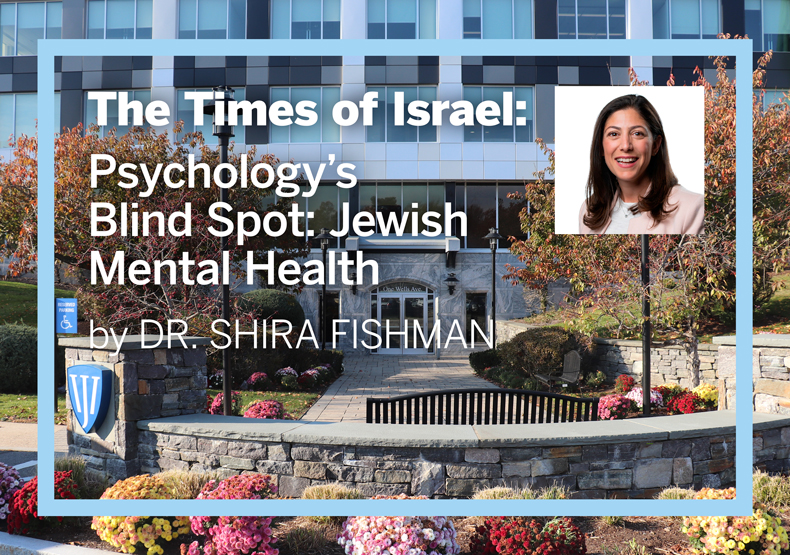
Dr. Shira Fishman, associate professor and inaugural director of the Jewish Mental Health concentration at William James College, published a blog post in The Times of Israel. In it, Fishman shares why Jewish experiences, including shared history, culture, ancestry, and exposure to antisemitism, warrant greater recognition within psychology’s multicultural framework. Drawing on recent developments within the profession and the growing need for clinician competence in addressing Jewish identity and antisemitism, it calls for enhanced education, research, and professional recognition to ensure equitable, ethical, and culturally responsive mental health care for Jewish communities.