
Three Lives of Impact, One Uncommon Honor: The Stories Behind Commencement's Honorary Degree Recipients
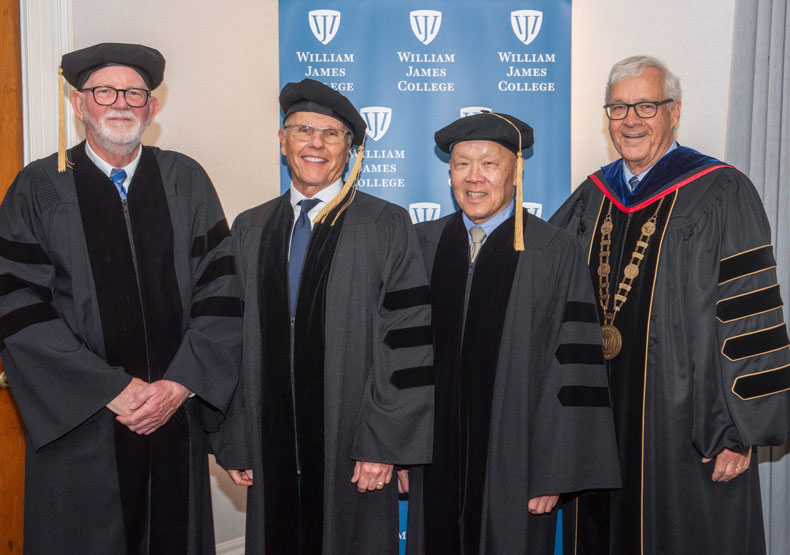
From Left to Right: Dr. Michael Hoge, David C. McCourt, Atty. Paul W. Lee, and President Nicholas Covino
In his opening remarks during the 2026 Commencement Ceremony on June 14, President Nicholas A. Covino PsyD addressed what he called the question of the moment among graduates: On which side of the cap does one place the tassel? After sharing his answer—the left side, unless one is a first-time bachelor’s recipient and then it’s the right—Covino joked that, in the end, it doesn’t really matter.
“But the Doctor of Humane Letters does really matter,” Covino continued, pointing to the highest degree an academic institution can bestow upon “really normal people” who have chosen to make a difference in the world through their work, demonstrating excellence, integrity, and a commitment to the service of others.
“Our aim is to lift up folks doing unusual things in the community which I hope will inspire you to follow suit,” said Covino, who suggested a handful of future honorary degree recipients were likely among the 315 individuals receiving diplomas.
This year’s honorary degree recipients, chosen for enduring impact in their respective fields, include a business leader and philanthropist; a psychologist and expert in behavioral health workforce development; and an attorney and advocate for the Asian American and BIPOC communities. Each was introduced by a William James College faculty member before receiving their Doctor of Humane Letters, honoris causa and corresponding academic hood.
Mr. David McCourt, Chairman and CEO of Granahan McCourt Capital
Nadja N. Lopez, PhD, Executive Director of the Center for Behavioral Health, Equity, and Leadership in Schools, welcomed guests in English and Spanish before introducing the keynote speaker. Beyond McCourt’s myriad accomplishments, Lopez pointed to his local roots (he was raised in Watertown), and the presence, curiosity, humility and conviction with which he listens.
“When you meet [Mr. McCourt], he authentically invites you to share your story, with everything about the interaction saying, your voice matters,” said Lopez of the constructive entrepreneur whose innovation has increased connection, equity of access, social capital, and creative education to millions of people around the world.
McCourt’s address to graduates centered upon the enduring influence of his high school sociology teacher, Dr. Covino, whose guidance shaped both his career and his life. Growing up in a racially and ethnically divided Boston, McCourt credits Covino with teaching him three simple but transformative principles: "Show up, listen, and put yourself in someone else's shoes before you respond."
Those lessons, he said, have become a daily measure of his own character. "Fifty years later, every night before I go to bed, I think to myself: Did I do a good job on all three of those things?"
For McCourt, listening is far more than a communication skill. “It’s an act of humility, an acknowledgment that other people are carrying a burden you don't know," he said, emphasizing that many of America's divisions stem from a simple truth: "We've stopped being curious and we've stopped listening."
Drawing on his experiences interviewing hundreds of people from vastly different political, cultural, and personal backgrounds for Amerigo: The Search for the American Dream—a documentary timed to coincide with America's 250th anniversary celebrations—McCourt described a surprising discovery:
"The longer we listened to one another, the less interested we became in what separated us and the more interested we became in what connected us." Beneath the disagreements and labels, he said, all people share the same fundamental hopes: to be happy, to keep their children safe, and to be understood.
As graduates prepare to enter professions dedicated to healing others, McCourt reminded them that they are stepping into a nation grappling with "a crisis of meaning, belonging, and connection", forces that often contribute to mental health challenges. He urged them to embrace understanding over judgement and comparison; to remember that their work matters; and to choose the meaningful path over an ordinary life.
“When you don’t really care what others think—beyond that you are honest and honorable—it makes you less afraid to fail”, said McCourt who concluded his remarks by returning to Covino's advice: "The only thing you need to remember... is if you show up, listen, and put yourself in other people's shoes…everything else becomes much easier.”
Michael Hoge, PhD, Professor of Psychiatry at Yale School of Medicine and Director of Yale Behavioral Health
Gemima St. Louis, PhD, Vice President of Workforce Initiatives and Specialty Training, greeted friends, family members, and other supporters in English and Haitian Creole before introducing a giant in the field of behavioral health work.
“While you may not be fully aware of it, you have directly benefited from [Dr. Hoge’s] life’s work,” St. Louis told graduates. She went on to call the roadmap of his design, one that continues to guide institutions like William James College in addressing the workforce crisis, Hoge’s legacy.
St. Louis underscored Hoge’s fundamental belief—that access to care is inseparable from the strength, preparation, and sustainability of the workforce that delivers it—as an example of both mentorship and leadership in action. She then offered graduates a second roadmap for navigating challenges ahead.
“As you enter this field, you will face systems that are complex, imperfect, and, at times, overwhelming. Dr. Hoge’s career offers a model for how to move forward:
See clearly.
Care deeply.
Build what does not yet exist.
And never forget the people who are at the center of this work.”
Paul W. Lee, Co-founder and Chair of the Asian Community Fund at the Boston Foundation
Catherine Vuky, PhD, Director, Asian Mental Health Program welcomed family and friends in Vietnamese prior to introducing a visionary leader, trailblazer, and unwavering advocate for justice, equity, and community well-being.
“Although Paul is not a mental health professional by training, he is—in the truest sense—someone who understands what this work is really about,” said Vuky of Lee’s strategic and deeply human leadership.
“He listens. He stays curious. And then he acts,” she said, using the pandemic-era fear and isolation among Asian communities as a prime example. By showing up with thoughtful questions, Lee discovered rising stress, anxiety, and depression among this group and convened a community coalition to better understand and respond to these needs.
“Paul Lee’s legacy is still being written—and it is already extraordinary,” said Vuky, pointing to a man who used every platform he was given not to elevate himself, but to open doors for others.
“[A man] who believed—and proved—that one person, working with intention and care, can effect systems-level change…and ensure that future generations inherit a more just and compassionate world.”
- Tags:
- Commencement
- In the Community
Topics/Tags
- Admissions Blog
- Faculty/Staff
- Alumni
- Students
- Partner Spotlight
- Expert Insights
- Press Release
- 50th Anniversary
Follow William James College
Media Contact
- Katie O'Hare
- Senior Director of Marketing and Communications
- katie_ohare@williamjames.edu
- 617-564-9389