
Introducing the Haitian Mental Health Network
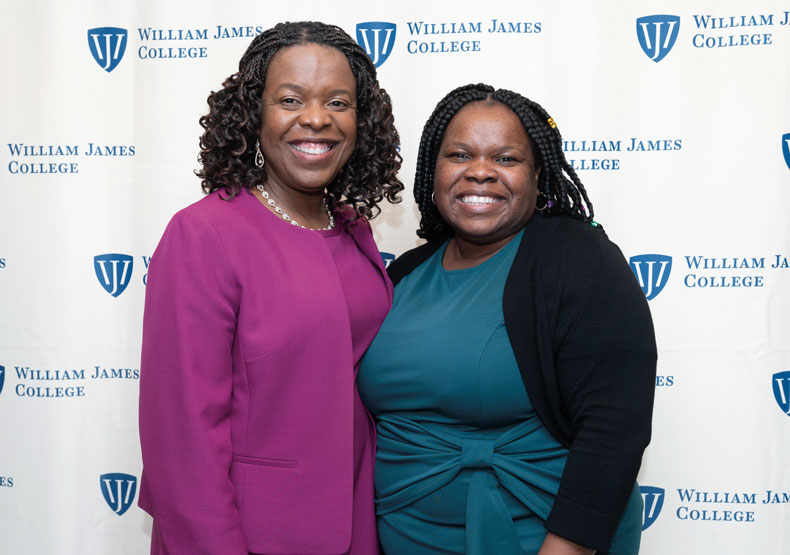
Vice President of Workforce Initiatives and Specialty Training, Gemima St. Louis, PhD (left), and Associate Director, Clinical and Community Services, Center for Workforce Development and Executive Director, Haitian Mental Health Network, Gina Dessources Benjamin, MSW, LICSW (right)
Building Collective Resilience Among Haitians Living in the Diaspora
In January 2010, a catastrophic earthquake near Port-au-Prince, Haiti devastated the Caribbean country and triggered a humanitarian crisis whose ripple effects reached Boston. As families were forced to relocate, city schools saw a sharp increase in the number of Haitian Creole speaking students in need of support that was not readily available. When an urgent call was issued in the community seeking mental health professionals, a Haitian psychologist and a social worker now affiliated with William James College, along with their colleagues, responded without hesitation, stepping forward to meet the need.
“Haitian clinicians were willing to give of their time, resources, and energy because they understood what was at stake,” recalls Gemima St. Louis, PhD, Vice President of Workforce Initiatives and Specialty Training. Among the core group of eight strangers who gathered for the first time in Mattapan to respond to the emerging crisis, there was a profound shared understanding: Beyond the challenges of acculturation, trauma would be a defining thread in the lives of the displaced children and their families.
“Since its inception, the Haitian Mental Health (HMH) Network has come to stand for resilience in the face of adversity,” says St. Louis, who spearheaded in-country relief efforts to address basic needs and provide Psychological First Aid in the months following the earthquake. As the immediate crisis diminished, community-based efforts continued.
“From the beginning, we have been leading with a shared love of and commitment to the Haitian community," says Gina Dessources Benjamin, MSW, LICSW, Executive Director, Haitian Mental Health Network, who, like St. Louis, was born and raised in Haiti.
Over the past 15 years, strong bonds have kept the HMH Network moving forward through ongoing challenges for their community. Over a 16-month period beginning in February 2024, the HMH Network hosted a 26-workshop series for 125 displaced individuals staying in emergency shelters across the state. During the same period, 200 new arrivals participated in multicultural/multilingual wellness workshops led by members of the HMH Network.
Today, the Haitian Mental Health Network serves as a vital bridge, connecting Haitian individuals and families with the mental health support they need while promoting culturally sensitive practices within the broader mental health landscape. Comprised of Haitian mental health providers, social services and healthcare organizations, and allies of the Haitian community, the nonprofit is dedicated to promoting greater awareness and understanding of mental illness and mental wellness in the Haitian community; facilitating community conversations on mental health; celebrating culturally and spiritually-based practices that foster community well-being; and creating supportive and inclusive learning environments to build a culturally and linguistically diverse behavioral health workforce.
“It’s really been a passing of the baton,” says Benjamin, nodding to deep expertise from a core group of founding mothers and mentors. In her current role as executive director, building upon this legacy by thinking about the organization’s long-term viability remains top of mind for Benjamin. Establishing a physical address at One Wells Avenue, with William James College (WJC) and partnering more closely, seemed a logical next step.
“As we transition to working more collaboratively with WJC, which has been a gracious host and generous supporter of the HMH Network, we are reminded that this work is deeply rooted in the community,” says Benjamin, underscoring the need for sustainable pathways going forward.
Through this strengthened partnership, WJC students will have more opportunities to engage with the HMH Network. In addition to ongoing service learning and experiential training, students can now participate as Network members in a wide range of community-focused initiatives—from conferences and workshops to mentorship and volunteer-based activities—further enriching their academic and professional growth as culturally responsive mental health professionals.
“The resilience of the Haitian spirit remains strong,” says Benjamin, who envisions the next chapter of the HMH Network’s development hinging on expansion. “From leaning into technology to bolstering advocacy efforts, we want to ensure folks get the care they need with as few barriers as possible.”
- Tags:
- In the Community
Topics/Tags
- Admissions Blog
- Faculty/Staff
- Alumni
- Students
- Partner Spotlight
- Expert Insights
- Press Release
- 50th Anniversary
Follow William James College
Media Contact
- Katie O'Hare
- Senior Director of Marketing and Communications
- katie_ohare@williamjames.edu
- 617-564-9389