
NAMI and You: Adventures in Mental Health Leadership and Advocacy
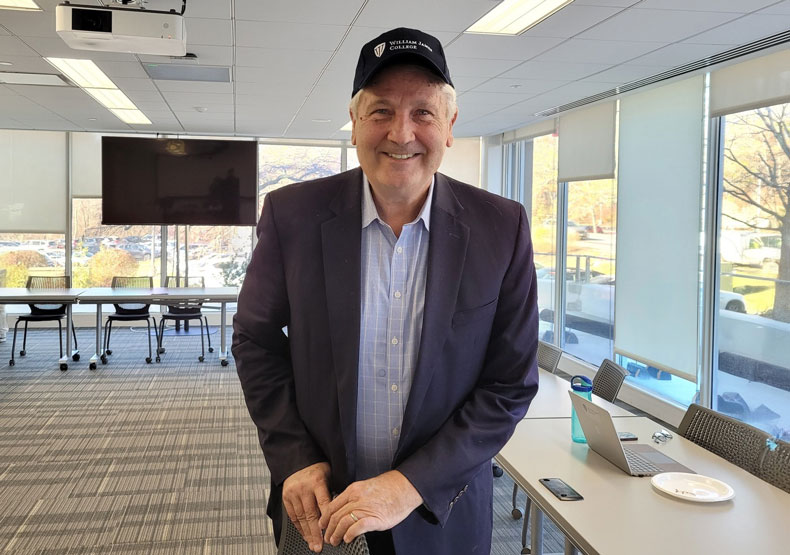
Ken Duckworth, MD is no stranger to the William James College community. In mid-June, the double-board certified psychiatrist was one of three honorary degree recipients at the 2025 Commencement Ceremony; last month, the chief medical officer of the National Alliance on Mental Illness (NAMI) came to campus to share his insights on mental health leadership and advocacy gleaned over the course of his career (including more than two decades at NAMI) and rooted in lived experience.
“Of course [when I was young], we did not talk about the obvious problem in the family,” says Duckworth, who grew up with a loving father who had bipolar disorder. In 1986, when applying for residency, he wrote about his lived experience in response to the prompt: Why do you want to become a psychiatrist?
“I knew it was radical to tell the actual truth, but mine was not the right answer," says Duckworth, who quickly learned there were two acceptable answers: I want to find out how people tick and I’m really interested in neuroscience. Not surprisingly, his unconventional-at-the-time essay was largely ignored. In interview after interview, Duckworth was peppered with questions about his volunteer work and college football (he attended the University of Michigan as an undergrad); only one person, at a world-famous facility not far from campus, told Duckworth his essay was a terrible reason to become a psychiatrist. The aspiring psychiatrist remembers leaving that place in tears and thinking, this isn't going to work.
It wasn’t until he visited the Massachusetts Mental Health Center (where Duckworth is currently on the faculty), that someone read his essay and decided: You have a father with bipolar disorder; you understand things in a different way.
“He didn’t tell me my essay was fantastic, or that I was the best candidate ever, but he did read my essay and wanted to talk about it,” says Duckworth, pointing to a shift in the mental health landscape.
Changing Landscape
The missing pieces in his own professional training proved powerful tools for Duckworth. “I never learned what real people had done to help themselves—in their own words—and how real families had figured out how to communicate better [when dealing with mental health diagnoses],” says Duckworth who credits having a family member with lived mental health issues as informing his career.
For a brief period in the 1990s, folks from the Longwood Medical Center’s residency program called on Duckworth to interview candidates who wrote about lived experience with mental health issues—from a mom with schizophrenia to a sister who attempted suicide. After a 13-year window, the phone calls seeking Duckworth’s expertise fell off; when he called Longwood, wondering if students had stopped writing essays about their personal experience, the answer shocked him: So many students are discussing their lived experience with mental health issues that we’ve got this covered.
“The world has really changed in some fundamental ways in terms of discussing the mental health experience,” says Duckworth, pointing to an uptick in celebrities (including Selena Gomez, who has more than 417 million Instagram followers) using their platforms to encourage dialogue—a trend he contributes in part to NAMI.
In 2003, Duckworth found his way to the nation’s largest grassroots mental health organization dedicated to building better lives for the millions of Americans affected by mental illness. The organization’s Family-to-Family support group is the only of its programs to have undergone a randomized control trial; in 2011, a landmark study found that the individuals in the active group of the study showed improved abilities to cope and feelings of empowerment—demonstrating the safe and effective nature of the 12-week program.
Advocating for Mental Health Parity
Duckworth’s treatment for cancer while a resident, in a beautiful facility where insurance covered everything, was likely the antithesis of his father’s experience being treated for bipolar disorder in a (now defunct) state mental hospital in the late 20th century. “I kept thinking about how crummy and dark it must have been,” says Duckworth, recounting his foray into advocating for mental health parity—a topic he brought to a Senate committee hearing in 2000. He spent a decade working for Blue Cross, where he counts getting rid of the methadone and naloxone copays among his biggest wins. During his time as medical director for the Department of Mental Health, he turned his attention to compassionate inpatient care and eradicating the use of restraints.
Every step of the way, he cites collaboration as the key to achieving positive outcomes.
Documenting Shifting Attitudes
In 2022, Duckworth authored NAMIs first book, You Are Not Alone. When explaining its focus on lived experience as expertise, one notable publisher was skeptical Duckworth could get participants to use their real names. “While that was true a decade ago, I found that folks were eager to share teachable lessons from their experience for the benefit of others,” says Duckworth, of the USA Today bestseller—the writing of which spanned 15 years and three CEOs. Delivered with the wisdom of a psychiatrist and the vulnerability of a peer, this comprehensive guide centers the poignant lived experiences of over 125 individuals from across the country whose first-person stories illustrate the diversity of mental health journeys.
Duckworth referenced a forward-looking project in which NAMI is partnering with leading academicians to create a set of guidelines aimed at getting folks thinking about AI in the mental health space—which could be up and running within the year.
As for Duckworth’s two cents on the coolest part about taking leadership jobs? “You get to be part of working the problem.”
About the Presenter:
Ken Duckworth, MD, is the chief medical officer of the National Alliance on Mental Illness (NAMI) and has worked with NAMI since 2003. Ken is board certified in adult psychiatry and child and adolescent psychiatry and is an assistant professor of psychiatry at Harvard Medical School. He was previously acting commissioner and medical director at the Massachusetts Department of Mental Health. Ken has worked on an assertive community treatment team, at an early psychosis program, at an elementary school, at a health plan, and with people who are unhoused. He is the author of NAMIs first book, You Are Not Alone, which focuses on lived experience as expertise and is a USA today bestseller. Ken’s passion for this work comes from his loving dad who had bipolar disorder. He lives with his family in Boston.
- Tags:
- Around Campus
Topics/Tags
- Admissions Blog
- Faculty/Staff
- Alumni
- Students
- Partner Spotlight
- Expert Insights
- Press Release
- 50th Anniversary
Follow William James College
Media Contact
- Katie O'Hare
- Senior Director of Marketing and Communications
- katie_ohare@williamjames.edu
- 617-564-9389