
The AI-Powered Professors: Preparing Students for a ‘Human-AI’ Workforce
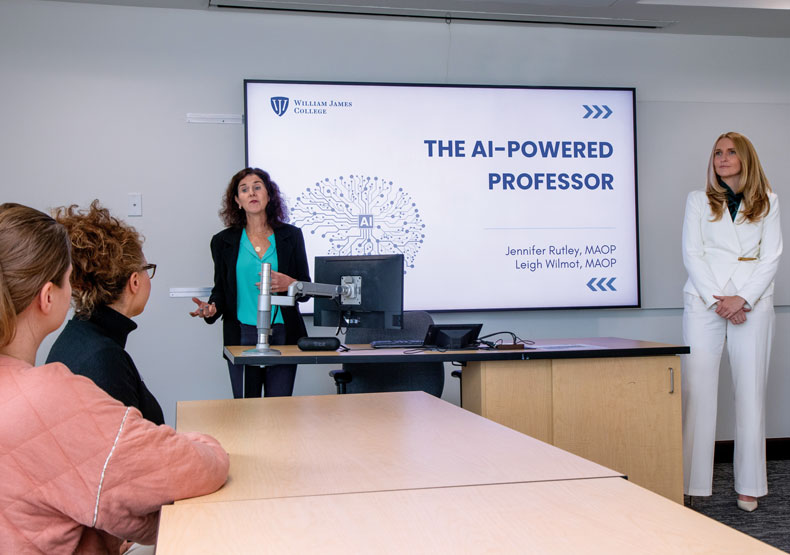
Jennifer Rutley and Leigh Wilmot lead a presentation for the Organizational and Leadership Psychology faculty. (Photography by Joshua Rizkall)
The era of an integrated human-AI workforce is here and William James College’s organizational and leadership psychology faculty are preparing students, and each other, for the impact of AI in classrooms and workplaces.
For organizational development consultant and WJC faculty member Leigh Wilmot, the changes introduced by AI make it an exciting time to be in the field, and readying the next generation of practitioners is key to helping companies and employees manage the transition.
“These are the organizations that our students are consulting to and stewarding during change,” Wilmot said. “It behooves us to teach students how to work with AI employees and AI-powered human beings, as well as managers who have to manage both.”
A graduate of WJC’s MA in Organizational Psychology program, Wilmot joined the William James community because of its practitioner-led program that stays current on the latest industry trends and academic research.
Wilmot partnered with fellow faculty member and current Leadership PsyD student, Jennifer Rutley, to lead a workshop for faculty on how to become an “AI-Powered Professor.”
Rutley’s doctoral program field placement project focused on adapting AI to her business as an independent consultant.
“This is a fundamentally shifting technology that will change how we all work,” Rutley said. “I wanted to understand the impact of AI on Organizational Development capabilities, like assessing employee engagement and supporting performance management, by scanning the tools.”
A Culture of Scholar-Practitioners
The workshop was modeled after one held by Wilmot for Mass General Brigham called “The AI-Powered Consultant,” but tailored to use cases for faculty and students.
Suzanne Devlin, Chair of the Organizational and Leadership Psychology department at WJC, connected Rutley and Wilmot to lead the workshop for OLP faculty.
“We are scholar-practitioners,” Devlin said. “We invite what people are doing in settings outside of higher education to our classrooms. We were excited about what Wilmot was doing with physicians at Mass General Brigham and Rutley was doing a fascinating field placement to look at enterprise AI tools in organizations so we invited them to share their experiences with faculty.”
During the workshop, the two categorized the types of AI into three key areas: generative AI, such as Large Language Models (LLM) like ChatGPT; ambient AI, which runs in the background such as transcribing a Zoom meeting; and agentic AI, which can complete tasks autonomously.
“If I’m a professor and I’ve run Intro to Organizational Psychology for the last ten years, but I want to introduce new trends and scholarship, I can prompt an LLM to do deep research for me,” Wilmot explained. “It can rove scholarly journals and government websites and act as a teaching assistant that pulls valuable information with incredible speed and skill.”
Generative AI can also be a strategic brainstorming thought partner on everything from syllabus creation to case study design; however, Rutley and Wilmot note that although AI is a part of this chain of brainstorming, it’s just the middle part of a human-AI-human process.
“You have to be a human to understand the context of what you’re doing, then use AI to brainstorm or digest, but then still have to be the human again to check, massage, and iterate what the AI returns back to you,” said Rutley.
“The technology is impressive but not flawless. Always ask it to check its work and check it yourself,” said Wilmot.
Meanwhile, ambient AI tools can summarize and take notes on calls, assess presentation skills during a lecture, and become a presence coach for faculty to help them with communication, while AI agents are transforming the workforce.
“The wild world [of industry] is being agentified,” Wilmot explained. “Many white-collar roles in data analysis and research will become the remit of AI agents who can use reasoning and judgment at their own initiative. This will fundamentally shift the workforce.”
Preparing for the ‘Human-AI’ Future
Wilmot points to three pieces of the puzzle in managing AI in the classroom: the role of AI for professors; what curriculum prepares students for a workforce of agents and humans; and how do students learn the core competencies to check the AI’s work.
“We compare it to the calculator,” Rutley said. “Now that we can do things we used to teach, are we losing baseline skillsets? If humans don’t know how to do a skill, they can’t check the AI. [We must] make sure we are still teaching the competencies in a world where AI creates a lot of shortcuts to get to knowledge.”
Devlin will work with faculty on an updated competency model that incorporates these technology-driven changes in the field. Faculty will work through a collaborative, open-dialogue process that fortifies the program’s signature assignments and ensures that students graduate with the competencies and transferable skills they will need.
“We want to make sure we are preparing students to work in a world that is AI-compatible,” Devlin said. “Our psychology-based program is grounded in the idea that change in our environments, organizations, and work groups, including changes like the introduction of robots, influences the psychological dynamics between individuals. We study those invisible forces to better understand and improve workplace interactions.”
This concept is an emerging aspect of organizations and WJC, but Devlin is confident that the students and faculty are up to the task.
“I’m proud to work in a place where students bring the organizational challenges they are experiencing, and we work together to solve them,” Devlin added.
“Change management is a foundational discipline of organizational and leadership psychology, and there’s a lot of change afoot,” Wilmot said. “Our future is bright, if we’re ready for it.”
AI Innovation Across William James College
Artificial intelligence is advancing across every corner of William James College.
The College’s AI Committee unites faculty and staff from multiple disciplines to
explore how generative tools can strengthen teaching, learning, and administrative
work. Across the institution, WJC is building the foundation for ethical, practical,
and human-centered use of AI in psychology and education. This is one example of how
our faculty are applying AI in the Organizational and Leadership Psychology department.
- Tags:
- Around Campus
Topics/Tags
- Admissions Blog
- Faculty/Staff
- Alumni
- Students
- Partner Spotlight
- Expert Insights
- Press Release
- 50th Anniversary
Follow William James College
Media Contact
- Katie O'Hare
- Senior Director of Marketing and Communications
- katie_ohare@williamjames.edu
- 617-564-9389