
What is Talent Management? Q&A with Concentration Director, Dr. Carlene Caldwell
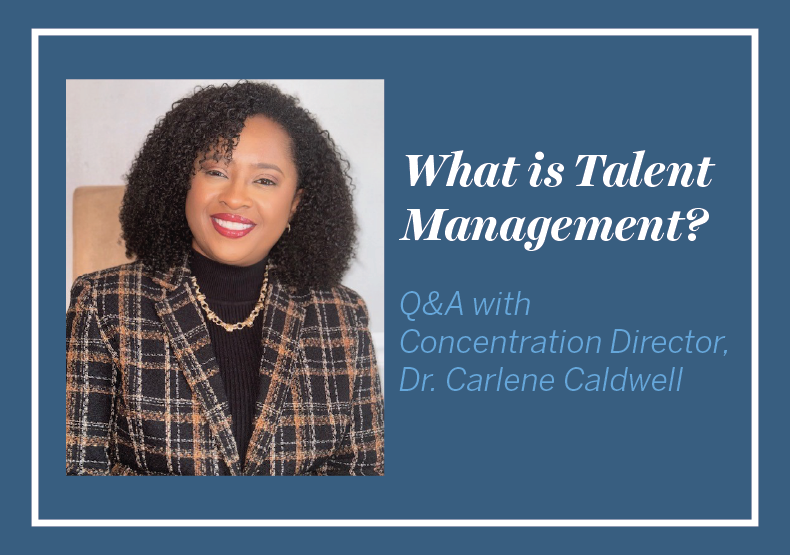
Are you interested in the field of talent management and learning how the people of an organization help it thrive? As part of the Master of Arts in Organizational Psychology program at William James College, you can pursue a concentration in Talent Management. We sat down with concentration director, Dr. Carlene Caldwell to learn more about what talent management is, why it’s important, and what the concentration at William James College looks like.
Q. What is Talent Management?
A. The high-level view is that talent management is strategic work where organizations are trying to attract, develop, retain, and advance people who are going to drive the business forward. It’s how organizations make sure they have the “Four R’s” which is the right people in the right roles, with the right skills, at the right time.
Q. How does talent management relate to the field of Human Resources?
A. Human Resources is the broader umbrella, it’s the bigger picture. Under HR you have different areas like employee relations, benefits, payroll, compliance. I can go on and on, but talent management is one of those specializations under HR that is focused on growth, capability, performance over time. Human Resources keeps organizations running smoothly, but talent management helps the organization grow stronger.
Q. What does a career in talent management look like?
A. Talent management is very versatile. Some common pathways or roles you might hear in the field are learning and development, leadership development, organizational effectiveness, employee experience managers, culture and engagement, succession planning, workforce planning, workforce development, performance management, career mobility managers, or career development. Basically, talent management people evolve into what organizations consider their trusted advisors around understanding people, understanding systems, and understanding performance.
Q. Why is talent management important in a business or organization?
A. For one thing, an organization is only going to be as strong as people systems. What organization can thrive, grow, or even survive without strong people with the Four R’s (right people, right roles, right skills, right time). When talent management is done right, it instills trust, but when it’s done poorly, then you see things like burnout, high turnover, or lack of development opportunities.
Talent management really matters because it helps organizations ask critical questions like: Do we have the talent we need to meet future business demands? Are we promoting the right people or just the most popular or loudest people in the room? Are we building a culture where high performers are encouraged to stay and grow? Are leaders developing the people they need or are they unintentionally driving people away?
Q. What are some misconceptions about the field of talent management?
A. One of the biggest misconceptions I hear when it comes to talent management is that it’s only training and development, but it’s much broader than that. Talent management includes assessment, it includes performance systems and succession planning. Talent management is very strategic and directly impacts business outcomes.
Another misconception that I’ve heard is it’s just another name, or a new name, for Human Resources. Talent management is part of human resources, but it focuses on the future. It’s about building readiness and making sure we have what we need to continue to move the business forward.
Lastly, I’ve heard that talent management is something that you only see at big companies and that’s just not true. Every company needs talent management in order to survive, whether it’s a huge organization or a startup.
Q. How does the talent management concentration fit into the Master of Arts in Organizational Psychology program at William James?
A. The talent management concentration really fits into the MA in Organizational Psychology (MAOP) program because of the combination of psychology and strategy. MAOP provides a psychological foundation about how people think and how they behave and respond. It dives into the psychological aspect behind moving the business forward through human capital. Talent management builds on that by giving students practical tools they can apply in the real world to understand and strengthen areas like development, talent strategy, culture, engagement, and retention.
Q. What would you say to someone who might be considering the talent management concentration?
A. The one thing I hope students take away from this conversation is that when you are part of the talent management concentration, we’re going to ensure that you leave with a people-strategy mindset that you can apply to any role in any industry because talent management is everybody’s business. That’s one of the things I want to call out about the concentration is that it’s open to all. You don’t have to be someone who is solely in the field of human resources in order to benefit from this concentration. It’s designed for students who want to understand how an organization grows and how organizations succeed through their people. Without talent, we have no business.
- Tags:
- Around Campus
- Admissions Blog
Topics/Tags
- Admissions Blog
- Faculty/Staff
- Alumni
- Students
- Partner Spotlight
- Expert Insights
- Press Release
- 50th Anniversary
Follow William James College
Media Contact
- Katie O'Hare
- Senior Director of Marketing and Communications
- katie_ohare@williamjames.edu
- 617-564-9389