
Turning Research into Real-World Impact: Graduate Students Participate in a Qualitative Study of Army Veterans
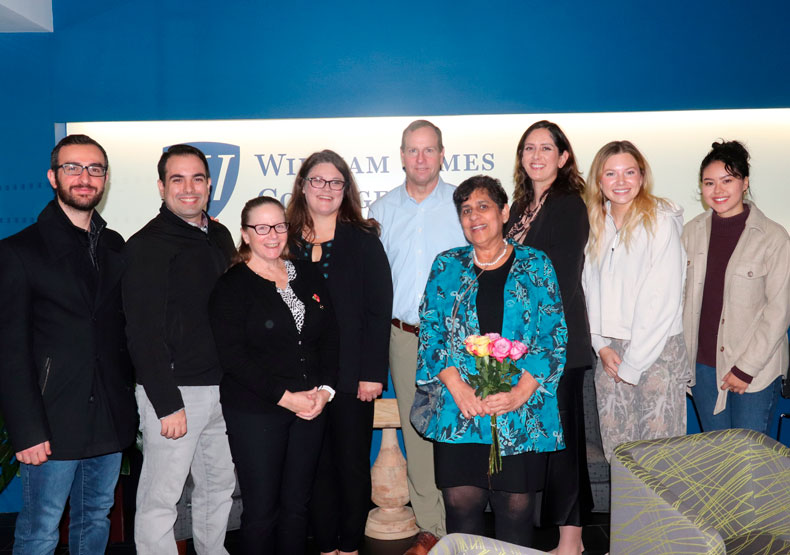
Veteran homelessness remains a persistent national challenge, one that reveals the vulnerable transition from military to civilian life and underscores the urgent need for research that centers veterans’ perspectives on the issue. For Jenny D’Olympia, PsyD, the topic is at once professional and deeply personal. As director of the Train Vets to Treat Vets (TVTV) program at William James College, she brings a layered perspective to her work: Lived experience as a Veteran, military spouse, and parent informs her commitment to preparing future clinicians to serve military and veteran communities. In 2023, when D’Olympia was invited to join a project examining pathways into homelessness among United States Army Veterans, she jumped at the chance—not only to collaborate with prestigious researchers from across the country, but also to provide her students the chance to participate in making a real-world impact.
“Qualitative research gives us the opportunity to tell unique and surprising stories that bring often unheard voices to life for the research community,” says D’Olympia, underscoring the importance of centering veterans’ lived experience—invaluable data a numbers-only approach misses.
After issuing invitations to apply and interview for the research positions, D’Olympia selected four graduate student co-authors with experience in the College’s Train Vets to Treat Vets® and MVP® (Military and Veteran Psychology) concentration. Read on to learn more from the perspective of a current student and co-author.
The Value of Applied Research Experience
A desire to better understand the mental health impacts of military service, including those challenges members of the military and veteran population experience at a disproportionate rate when compared with civilians, ultimately drew Zachary Ginsburg, MA to the PsyD in Clinical Psychology program at William James College. While not a veteran himself, the fourth-year doctoral student has family members who served during World War II and in Vietnam as well as friends who are active-duty service members, factors that made the College’s Military and Veteran Psychology concentration a natural fit.
“Advocating for this small percentage of adults in the United States is a passion I’ve been able to expand upon at William James College,” says Ginsburg, a Health Profession Scholarship Program recipient through the Department of Veterans Affairs. In the four years since he arrived on campus and introduced himself to D’Olympia as a civilian keen on working with veterans, Ginsburg has been intentional about expanding his learning beyond the classroom. Opportunities to work in the community and facilitate training programs, coupled with guidance from mentors like Sonia Suri, PhD and Angela Taveira-Dick, PhD, have proven profound in growing Ginsburg’s scope of understanding. Given an interest in disparities among the military and veteran population—spanning income and employment to housing and healthcare—it’s no surprise Ginsburg jumped at the chance to connect with veterans willing to share their personal stories.
“With qualitative research, the data has a face which allows us to better understand individuals’ struggles from their own perspective as opposed to what the prior research might indicate,” says Ginsburg, calling the experience a real privilege. In total, he and his colleagues completed fifty-five interviews over a four-month period—with Army veterans identified via the national Army Study to Assess Risk and Resilience in Servicemembers-Longitudinal Study(STARRS-LS)—allowing them to analyze trends through a non-numerical lens.
“Students were involved throughout the entire research process—from developing the interview guide and conducting interviews to coding data, executing qualitative analysis and editing the manuscript.,” says D’Olympia. The resulting paper, Pathways Into Homelessness and Perspectives on Prevention: A Qualitative Study of Army Veterans, was published March 2, 2026 in PLOS One.
Real-World Impact
Aimed at complementing existing longitudinal survey data, the qualitative analysis revealed a trio of primary pathways to homelessness according to veterans:
1. Financial challenges while reintegrating into civilian life;
2. Planning challenges around the transition; and
3. Interpersonal disruptions upon returning to civilian life (see Fig 1).
For all involved, the value of this research extends beyond what was studied to identify what changed because they studied it.
“Institutional impact measures how research moves off the page and into practice—changing how we train students, support communities, and make decisions,” says D’Olympia, pointing to key findings from the qualitative study. The prevailing measures identified by veterans, insofar as what could have prevented their homelessness, include enrolling veterans in services prior to separation, decreasing barriers to receiving VA disability benefits, and enhancing access to mental health care. Students’ work on this study has already opened the door to future opportunities.
“What we are doing right now could potentially become the way suicide prevention is done for the entire military,” says D’Olympia, pointing to a U.S. Department of Defense-funded, multi-institution collaboration in which she was invited to participate.
Building on the STARRS predictive modeling foundation, this project assembled subject-matter experts across digital mental health, suicide prevention, and implementation in military settings to design and evaluate a trio of linked interventions in response to rising active-duty suicide rates. The study, SAFEGUARD: Transforming Military Suicide Prevention Through Predictive Analytics and Targeted Interventions was published February 27, 2026 in Springer Nature.
Meanwhile, the Henry Jackson Foundation, a nonprofit that's been supporting medical research for the U.S. military since 1983, has been given a grant to assist in the clinical piece of developing an intervention for Army soldiers facing hospitalization for mental health reasons. D’Olympia’s role in helping develop the manual and working with clinicians to do the training means she’s uniquely poised to involve her students—“in any way I possibly can in everything that I do,” she says. D’Olympia’s dedication means William James College students are creating a nationwide database of support programs and participating as role play volunteers tasked with testing intervention procedures and implementing them. Next step: Continuing to support training and clinical implementation as part of a larger study enrolling 1,500 Army soldiers—paving the way for future students to participate in groundbreaking research opportunities while pursuing their degree at William James College.
“The resources surrounding students at William James College—from faculty who are subject-matter experts in specific niches to practicum supervisors with deep experience serving diverse populations—are not only abundant but also readily available to anyone willing to go the extra mile,” says Ginsburg, who speaks from experience. “You just need the willingness and awareness to seek them out.”
- Tags:
- Research & Advocacy
Topics/Tags
- Admissions Blog
- Faculty/Staff
- Alumni
- Students
- Partner Spotlight
- Expert Insights
- Press Release
- 50th Anniversary
Follow William James College
Media Contact
- Katie O'Hare
- Senior Director of Marketing and Communications
- katie_ohare@williamjames.edu
- 617-564-9389