
Tips for Supporting a Young Adult with Cancer
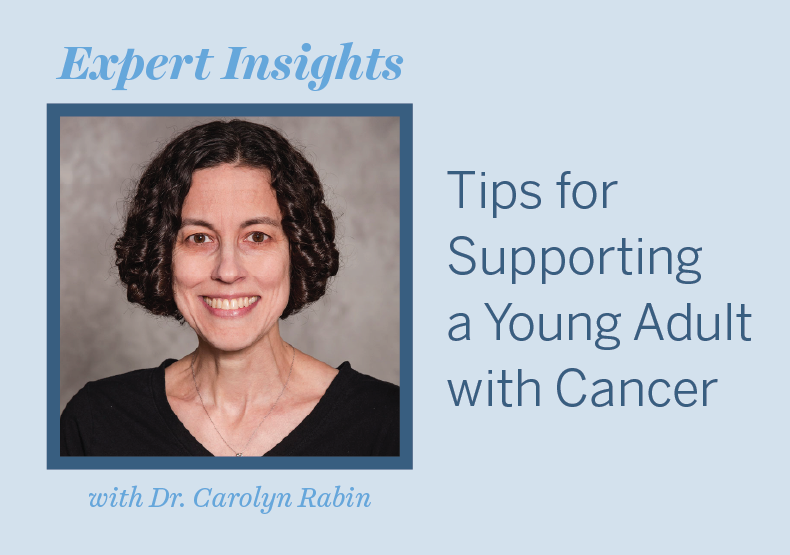
If you know someone who has been diagnosed with cancer, in particular a young adult, you may be struggling with how to support them in meaningful ways. We spoke with Carolyn Rabin, PhD, director of the clinical health psychology concentration, for tips on how to talk with, support, and be there for young adults who have been diagnosed with cancer. Here is her advice:
Listen.
Make it clear that you’re available to listen to their concerns. Young survivors often avoid talking about what they are going through because they don’t want to upset or burden others or don’t think others will understand. Make it clear that you want to hear whatever they are comfortable sharing. For example, you could say, “If you feel like talking about what you’re going through, I’m here.”
Validate.
Try to avoid saying phrases like “It will all be okay” or “You’re going to be fine!” While you may feel the urge to provide reassurance, this approach could feel invalidating to a young adult cancer survivor. Instead, listen and reflect back what you hear. For example, you could restate the survivor’s concern (e.g., “It sounds like you are really worried about how treatment will impact your ability to continue working”) and then acknowledge that they are going through something difficult (e.g., “That sounds really tough.”)
Offer Specific Support.
Making general offers of support—such as, “Let me know how I can help!”—puts the burden on the survivor to figure out what you can do for them. They may be reluctant to suggest anything, not knowing how much help, or what type of help, you are willing to provide. Instead, make more concrete offers of support, such as offering to pick up groceries, cook a meal, drive them to a doctor’s appointment, or do household chores.
Make Connections.
Young adult cancer survivors often say that it’s hard to find others their age who have experienced cancer, which can be an important support system for cancer survivors. If a young survivor is looking to make those connections, you can help by researching programs or support groups in their area or you could suggest reaching out to an organization that serves young survivors such as:
Don’t Expect Them to Be Over It.
Young adult cancer survivors sometimes feel that, as soon as their cancer treatment ends, others expect them to just move on with their lives as though everything is back to normal. Be aware that young adult survivors may still be processing the experience and/or dealing with long-term impacts from treatment and you should continue to provide support.
Educate Yourself.
You may be able to better relate to a young adult cancer survivor if you research the type of issues they may be experiencing. If you’re reading this article, you probably already are interested in educating yourself on ways to help. You should also consider researching topics such as body image concerns (as a result of treatment-related changes to their body), anxiety about upcoming medical tests, or fear of a cancer recurrence. Also be aware that young adult cancer survivors are at higher risk for mental health issues such as anxiety and depression and might need support with these concerns as well.
Find Professional Support.
Overall, there are limits to how much support you can provide for a friend or family member who is struggling with a cancer diagnosis. If the young adult cancer survivor you know seems down or anxious much of the time, they may benefit from talking to a licensed mental health provider. You can offer to help them find a counselor, social worker, or psychologist who has experience working with cancer survivors. (Psychologists who do this type of work are sometimes called health psychologists.) Different types of therapy have been shown to be effective in helping cancer survivors experiencing distress including cognitive behavioral therapy (CBT) and acceptance and commitment therapy (ACT).
Topics/Tags
- Admissions Blog
- Faculty/Staff
- Alumni
- Students
- Partner Spotlight
- Expert Insights
- Press Release
- 50th Anniversary
Follow William James College
Media Contact
- Katie O'Hare
- Senior Director of Marketing and Communications
- katie_ohare@williamjames.edu
- 617-564-9389